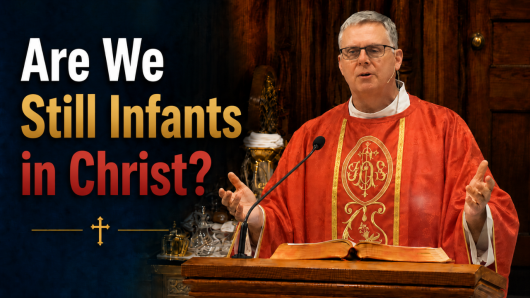
Let Jesus Accomplish His Purpose in You

Fr. Tyler Mentzer, MIC, invites us to rediscover the heart of the Gospel—the very purpose of Christ. When Jesus declares, “Behold, I cast out demons and perform healings today and tomorrow, and on the third day I accomplish my purpose,” He reveals the mission that defines His life and ours: to bring salvation, to dwell within us, and to unite us forever to Himself.

From Baptism, where we are born of water and the Spirit, to the Eucharist, where we receive His Body and Blood, the Lord draws us into His divine life. His mission is not distant or abstract—it is personal. God’s purpose is to live in you, to make His home within your heart, to press you to His merciful Heart and fill you with His peace.

But He waits for your “yes.” The salvation of God is not forced—it is offered. When we open our hearts and say, “Jesus, enter my heart,” we allow His purpose to be fulfilled in us. That is the meaning of peace, the fullness of life, and the destiny for which we were made: to become a dwelling place of God.

Added to Favorites!
Added to Watch Later!

You might also like...

The readings for this homily: https://bible.usccb.org/bible/readings/123025.cfm The mystery of Christmas overturns every illusion of self-salvation. God does not wait for humanity to climb back to Him. He comes down. Father Anthony Gramlich, MIC, draws us into this central truth of the Incarnation: Fallen humanity cannot raise itself by its own efforts. Grace is not something we generate. Redemption begins with divine humility.
Fr. Jason Lewis reminds us on the Feast of the Guardian Angels that each one of us has been given a personal heavenly companion from the moment of our birth until death (cf. Catechism 336). Jesus Himself teaches: “Unless you turn and become like children, you will not enter the kingdom of heaven” (Mt 18:3). Why? Because children know their dependence. To be childlike before God is to recognize our total need for His grace.
The Gospel presents a man described as “full of leprosy.” Not partially wounded. Not mildly afflicted. Completely sick. And yet this is the man who is healed — because he approaches Jesus correctly. Father Anthony Gramlich, MIC, explains that Scripture reveals three responses to spiritual leprosy. The first is pride: refusing to see one’s own sin while accusing everyone else. This leprosy cannot be healed because it denies the wound. The second is despair: seeing the sin clearly but believing mercy is impossible. This leprosy turns inward and never reaches the Physician.