The Saint Who Made It Cool to Be Catholic
The Saint Who Made It Cool to Be Catholic

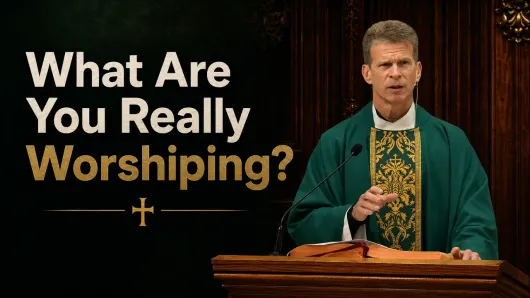
In today’s Gospel (Luke 12:39–48), Jesus calls us to vigilance—to be faithful stewards who live every moment ready for the coming of the Lord. “Much will be required of the person entrusted with much,” He says. That same spirit of responsibility and readiness defined one of the greatest saints of our time: St. John Paul II.
Fr. Mark reflects on how John Paul II lived his faith as a dynamic witness to truth and mercy. He was clear on what it meant to be Catholic and unafraid to proclaim it. His Catholicism wasn’t something separate from life—it was the very center of his being. John Paul II understood that faith is not meant to restrict us, but to set us free, helping us become the men and women God created us to be.
This clarity of truth was united with deep prayer. Those images of John Paul II leaning against his crucifix were not signs of weariness, but of communion—he was speaking to the living God. His intellect and mysticism worked together: the philosopher-pope who thought deeply and prayed even deeper.
Fr. Mark reminds us that John Paul II’s message remains urgent. His defense of the dignity of the human person and his devotion to Divine Mercy go hand in hand. Mercy, as he taught, restores our dignity and reminds us of who we are—beloved sons and daughters of the Father.
May we follow his example by living courageously Catholic lives, uniting truth with mercy, and staying prepared for our Lord’s return through faith, prayer, and fidelity to the Gospel.
You might also like...