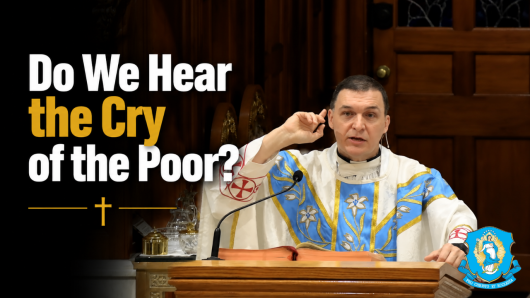
The Battle Within: Finding Mercy in Our Misery
The Battle Within: Finding Mercy in Our Misery

Fr. Anthony Gramlich, MIC, draws a powerful connection between Dr. Jekyll and Mr. Hyde and St. Paul’s words in Romans 7. Both speak of the same inner struggle — the war within every human heart between good and evil, grace and sin, the saint we long to be and the sinner we often are.
Even St. Paul, one of the Church’s greatest saints, confessed this interior battle: “I do not do the good I want, but the evil I do not want is what I do.” Though he knew the Law of God, knowledge alone could not make him holy. Like a carpenter who reads manuals but never picks up a hammer, knowing the faith without living it leaves us unchanged.
The real turning point comes when we acknowledge, like Paul, “Miserable one that I am — who will deliver me from this mortal body?” The answer is Christ. It is only through Jesus and His Divine Mercy that we are healed, renewed, and made whole. The Lord invites us to exchange our misery for His mercy — to bring Him our sins, our failures, and our weakness so that He may fill us with His grace.
As St. Faustina records in her Diary: “The greater the sinner, the greater his right to My mercy.” Divine Mercy transforms our weakness into strength, our guilt into gratitude, and our despair into hope. No matter how strong the battle within, Jesus Christ can bring peace to every divided heart.
You might also like...